
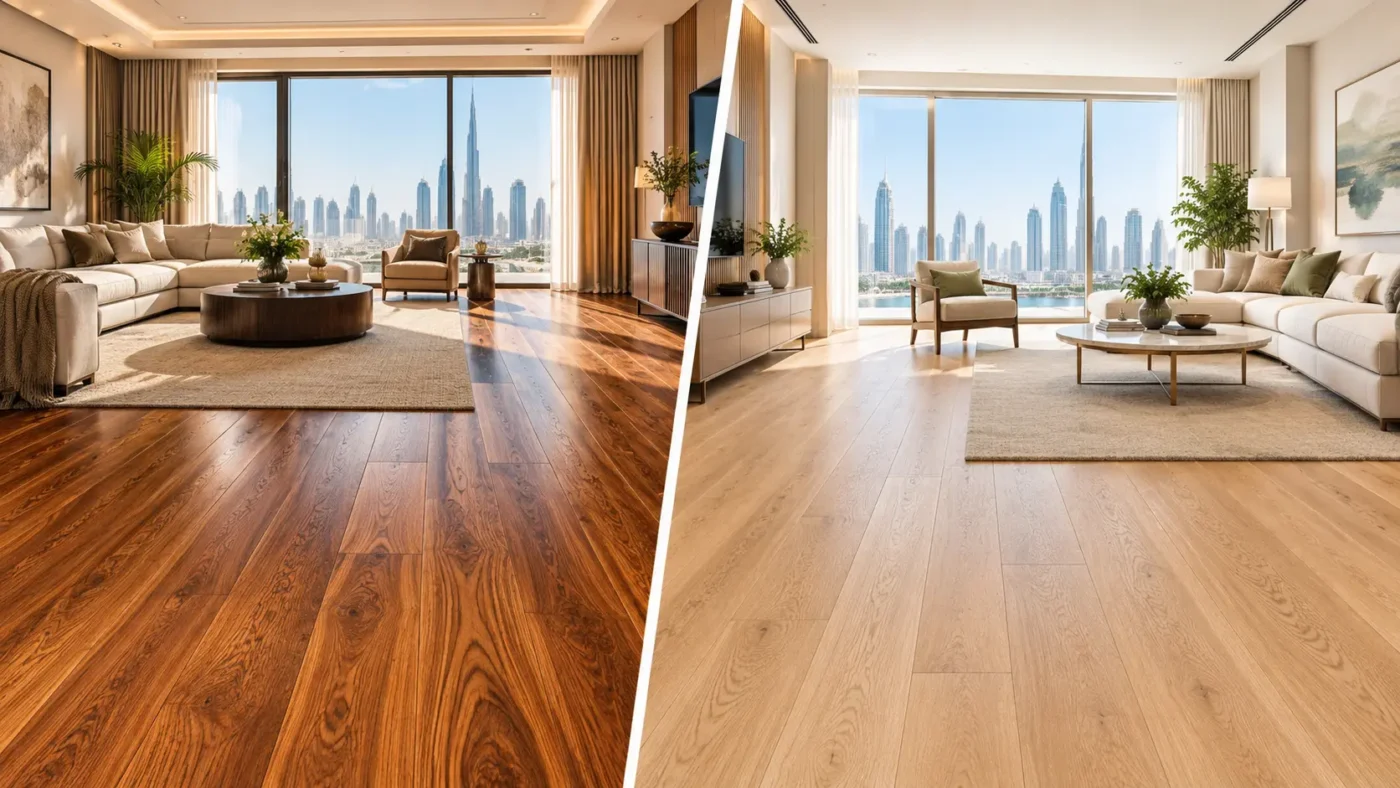
Choosing wood flooring in Dubai involves more than comparing appearance, price, or species. The local climate affects how flooring performs over time, especially with high temperatures, air conditioning, humidity and prolonged sunlight exposure. Solid teak and engineered wood are both established flooring options, but they respond differently to these conditions because of their construction and moisture behaviour.
Installation quality, room conditions, maintenance, and daily use also influence long-term performance. Understanding these factors makes it easier to choose which flooring type works for your space. This guide compares solid teak and engineered wood flooring across durability, stability, maintenance and suitability for Dubai homes.
Understanding Dubai’s Climate and Its Effect on Wood Flooring
The summer heat here can be demanding on building materials. Temperatures can exceed 45 degrees Celsius for weeks at a time, and coastal humidity often rises above 80 percent, particularly in areas like Dubai Marina or Jumeirah Beach Residence. Central air conditioning often runs nearly around the clock, creating an indoor environment that can differ sharply from the outdoor air each time a door opens.
Wood responds by absorbing and releasing moisture, expanding when humidity rises and contracting when the AC dries the room out again. A floor installed without accounting for this cycle rarely develops problems immediately. Instead, issues can develop gradually over one or two summers, as boards begin to cup at the edges or gaps appear between planks. This is an important consideration for any flooring decision in the region since the material must withstand repeated changes in temperature and moisture.
What is Solid Teak Flooring?
Teak flooring in Dubai has a long track record, and the reason comes down to the wood itself. Teak has a naturally high oil content, which is unusual among hardwoods and gives it built-in weatherproofing. Shipbuilders have relied on this exact property for centuries, using teak decking on vessels that spend their entire working life soaked in salt water and baking sun.
A solid plank is cut from one piece of timber, top to bottom, with nothing layered underneath. This solid structure lets it be refinished again and again, often extending a floor’s usable life past fifty years when it’s managed well. Teak sourced from established Asian forests has a tight, straight grain and a rich golden tone that deepens over time with sunlight.
What is Engineered Wood Flooring?
Engineered wood takes a completely different approach to the same problem. Instead of one solid piece, each plank is built in layers: a real wood veneer on top, bonded to a core of plywood or high-density fiberboard underneath. The layers run in alternating grain directions, which helps improve the plank’s dimensional stability. This cross-grain construction keeps the plank from moving as much when humidity shifts.
This is why engineered wood is often considered for ground rooms, kitchens, and other areas where humidity levels can be less predictable. The thickness of the top veneer varies between products and affects how the floor can be maintained over time. Thicker veneers may allow for light sanding once or twice, while thinner veneers generally cannot be refinished once the surface layer has worn through.
Durability: Solid Teak vs. Engineered Wood
Put the two side by side under actual Dubai conditions, and the comparison becomes more nuanced. Teak’s density and oil content slow down the swelling and shrinking that usually affects solid hardwood, so it holds its shape better than most other solid species when humidity spikes. That said, it is still a solid wood product, and it will move more than engineered flooring over the same stretch of extreme weather.
Engineered wood offers greater dimensional stability. The layered core does not react to temperature and moisture the same way as a single species of solid timber, which is why it is often specified for villas with inconsistent AC schedules or apartments closer to the coastline. In practice, a properly installed teak floor and a properly installed engineered floor can both perform well for years. Installation quality and how the space is used can have a greater effect on day-to-day performance.
Moisture Resistance: Solid Teak vs. Engineered Wood
This is the clearest point of distinction between the two. Teak’s oil isn’t a surface treatment that wears off. It’s part of the wood’s cellular makeup, so its water resistance doesn’t diminish the way a finish coat eventually does. This is a real advantage in spaces where moisture is a recurring issue.
Engineered wood manages moisture through its structure rather than through the species used for the top layer. The core resists warping reasonably well, but that thin veneer on top is more exposed. A spilled drink left too long, or water tracked in from a pool deck, can damage the surface layer in a way that’s harder to sand out, simply because there’s less wood there to work with. For bathrooms, kitchens, and entryways near balconies or outdoor areas, teak’s natural resistance tends to matter more. In climate-controlled living rooms and bedrooms, either option generally performs well.
Maintenance Requirements for Dubai Homes
Teak requires more hands-on care. Periodic oiling helps maintain its natural resistance, and because it can be sanded back to bare wood repeatedly, even significant scratches or worn areas can be corrected rather than left untreated. Most owners plan on refinishing every decade or so, depending on foot traffic.
Engineered wood generally requires less routine maintenance initially, since factory finishes are often fairly resistant to scuffing when new. The tradeoff becomes more apparent over time. With only one or two refinishing cycles available before the veneer wears through, there is less scope to repair damage once it appears, which can mean replacement rather than restoration.
Both materials perform better with steady indoor humidity, somewhere around 40 to 60 percent, along with basic care: wiping up spills promptly, using felt pads under furniture legs, and limiting direct sunlight on the floor where possible to prevent uneven fading.
Cost and Long-Term Value
Solid teak costs more upfront. This reflects the raw material, as dense, slow-growing hardwood milled into solid planks is more expensive to produce. Engineered wood is generally more budget-friendly, so it is often chosen for larger projects or renovation budgets that need to stay within a set limit.
Teak tends to have an advantage over the long term. Because it can be refinished several times, a well-maintained teak floor can outlast multiple cycles of an equivalent engineered product, spreading the higher initial cost across a much longer lifespan. Engineered wood has a lower initial cost and installation expense. However, it can only be refinished a few times, which may mean replacing the flooring sooner, particularly in busy households or commercial settings.
Which One Should You Choose?
There is no single right answer here, as it depends on the room and how the property is used. Bedrooms, living rooms, and other climate-controlled spaces can accommodate either material, and the decision often comes down to budget. Areas that experience higher humidity or occasional moisture, such as entryways, spaces near balconies, and kitchens, may benefit more from teak’s natural resistance.
If you plan to stay in a property for fifteen years or longer, teak can offer better value as it can be restored rather than replaced. If you are working with a rental property, a shorter ownership period, or a large-scale project where budget takes priority over longevity, engineered wood may be a more practical option.
Choosing Between Solid Teak and Engineered Wood Flooring in Dubai
No flooring material fits every property in the same way. Solid teak holds up well for homeowners who want a floor they can sand and refinish over the years, and its natural oils give it excellent moisture resistance. Engineered wood can also work well, especially in rooms where humidity is harder to keep steady or where the upfront cost needs to stay manageable.
The room matters as much as the material. A kitchen or entryway near a balcony sees more moisture than a bedroom, so what works in one part of the house may not work in another. Before committing, check the subfloor, installation method, room conditions, and daily use.
If you are comparing solid teak vs engineered wood flooring in Dubai, consider these factors before choosing a material for your space. Speak with a flooring professional to discuss the most suitable option for your property.
